Thursday, December 6, 2018

USANS STORY PROJECT 7-DEC 2017- JUSTIN KOSKI

ISHPEMING, MI TOURNAMENT IN 1937.
STILL GOING STRONG 80 YEARS LATER- ISHPEMING, MI TOURNAMENT IN 2017.
CURATOR'S NOTE-  Justin Koski is Executive Director of the US Ski and Snowbard Hall of Fame in Ishpeming, MI.  He pens a beautiful tribute to both Ishpeming and ski jumping, below.  To see more on the Hall, click here.

JUSTIN KOSKI
Executive Director | U.S. Ski and Snowboard Hall of Fame
Justin@skihall.com
This is a story of ski jumping as a way of life, a tradition, a community and a culture. From my office window, I see a bluff that once housed Homicide Hill – a popular jump in the 1910’s. I can walk to the window and look southwest to see Last Bluff which also had jumps coming off two sides of it used for competition in the 1920’s. If I go upstairs and look southeast I can see the very tippy-top of the 90-meter Suicide ski jump. I am in the heart, soul and birthplace of organized skiing in America. Do you know where I am?
Growing up here I tried jumping ONCE. I admired jumpers like Rudy Maki, Coy Hill, the Bietalla’s and many others. I listened to these guys tell ski jumping stories after golf for hours some nights when I was young. They were local legends with international accolades. They were extraordinary athletes and kind, gentle souls with a fierce competitive bone hidden deep down in each one of them! You didn’t have to jump to be embraced by them, you didn’t even have to ski. It didn’t matter what you did as long as you competed hard and drove for one thing – winning.
For over 65 years, my family has piled in the car and headed out to Suicide for the Annual ISC Ski Jumping Tournament. This year marks the 132nd annual event making it the longest running annual outdoor sporting event in North America. Today jumpers fly farther and the gear is a lot different but the community support and engagement has never wavered. We are a community who will forever embrace our jumping culture and keep the tradition alive. We support what we love. We are Ishpeming!

USANS STORY PROJECT 6-DEC 2017- JASPER MEYER

JASPER MEYER TOSSING THE V AND CATCHING BIG AIR on the Ford Sayre/Hanover (NH) K32 while amazed classmates watch from the knoll.
CURATOR'S NOTE-  Jasper Meyer is a senior at Hanover High School and one of the captains of its 2017-18 ski jumping team.  Yes, NH is the only state in the nation that offers sanctioned high school ski jumping and most competitors, like Jasper, arrive as freshman having never jumped before.  The energy around these high school practices and competitions is exhilarating and infectious (as Jasper captures so well in this story).  And best of all, the team that wins states is effectively the NATIONAL CHAMPION!  An honor that last year went to Kennett High School (North Conway, NH).  Hanover was second... watch the video here

JASPER MEYER
Hanover High School Ski Jumping Team
Lyme NH

I crave this high. I sit atop the towering jump. Music blares over the crowd. My eyes scan across the horizon, pausing at the soft light of Baker Tower. This view has become one of my favorites. I reach back and hammer my bindings into place for the third time -- a reflexive habit. I dig my edges into the tightly melded track. For a second, I feel the nervous ghosts of all my past tumbles try to force themselves into my head. I gently push back, feigning poise in my posture. The official waves me off, and I take five deep breathes, expelling all thoughts of the icy sheet I will land on in seconds.

My mind drifts away from my body like I’m nervous during a speech. I watch myself, as I have so many times on the iPad, zooming down the jump on my skis. Keeping a tight tuck to achieve minimal air resistance. Hands back. Body forward. I see my padded lycra suit stretching at the seams as I enter a deeper squat. My name tag pokes out of its neck. Jasper Meyer 2015-16 it says, but the M and 0 have almost completely faded into the winters’ air. The suit has smacked the snow many times since Coach dragged that Sharpie over the tag, christening its seams to protect me for a year, identifying its green fabric as my second skin for the winter. My helmet rides atop the suit. An obvious hand-me-down. Three visible name tags peek out from below mine. Three other names who understand the distinct sensations I feel now. Off the back of the helmet, right next to the Marker logo, a green ribbon streams away -- it was attached last year to commemorate an ill coach. I don’t know him, but it doesn’t matter. He knows this.

My slide is coming to an end. I’m reaching the critical point: the takeoff. The pine boughs stuck into the snow tell me when to push. I load my power up, ready for launch. Suddenly, my knees lurch upwards, straightening my legs. My entire body stiffens as if shocked without warning. I got it. The wind catches my suit, hitting me with the force of my speed all at once. Like a hand angled up outside the car window, I begin to rise. I see nothing. I pull my chin forward over my skis and reach for distance. The boards strapped to my feet begin to cut through the air, spreading into a V as naturally as a flock of migrating geese. Time seems to slow, but my thoughts are few.

The landing is the most treacherous part. At such high speeds, one slip leads to a steep hospital bill. The snow acts like concrete, and a fall means a forty mile per hour blow to it. I’m totally unaware of these truths in my decent. I let myself glide out as far as possible before setting my skis on the ground beneath me and letting gravity apply pressure. My senses snap back into focus. All of a sudden, I can hear my the crowd’s clap and feel the nippy night blowing against my face. I landed it. I turn around to look at the jump above me and don’t have time to react before my nose batters into the crusty earth. Embarrassed by my rookie mistake, I pull myself up and apply snow to my leaky face. Although I hear Coach’s laughing, I still feel the high -- the flying high. I feel the rush I yearn for every second of the day. Nothing makes me smile easier than this rush: the adrenaline pumping through my veins; the sense of accomplishment; the wrangling of fear; the joy of doing something insane. I crave this high. I wish all the people who ask me why could feel the high I do right now.
 

USANS STORY PROJECT 5-DEC 2017- STEVE GASKILL

WHEN WE WERE YOUNG(ER).  Steve Gaskill's Nordic Combined Rat Pack of the late 70's.  L-R Pat Ahern, Glenn Joyce, Mike Devecka, Chris Axselson, Coach Steve Gaskill, Kerry Lynch, Jon Zdechlik, and Gary Crawford.  Photo thanks to Walter Malmquist, also a member of the team.
CURATOR'S NOTE-  Success has many fathers so there are a number of people you can point to who deserve credit for the USA Nordic combined medals but I think many would agree that one of the first rungs on the ladder was Steve Gaskill who cobbled a tiny budget and a bunch of passionate kids into something that caught the world's attention.  To read a brief interview with Steve, now a professor at the University of Montana, click here, To check out Steve's TEDx talk on on the connection between movement and learning, click here.

STEVE GASKILL
Missoula, MT
Steven.Gaskill@mso.umt.edu

BUSTED FOR DRUGS
1978 was the year of the Nordic World Championship in Lahti, Finland.  It was also a few years after the advent of CERA F, the mystical SWIX powder wax that could be really fast in snow near 32Ëš F.  I was packing the night before our departure for Lahti when I received a call from the owner of an American ski wax company.  He wanted to know if I would like to try the new CERA F like fluor wax that he had developed.  “Of course,” I quickly answered.  Who wouldn’t love a substitute for the $100 small Swix vials when I was operating on a shoestring budget.

The problem was, he was in Buffalo, New York, and I was leaving for Finland the next morning.  No problem he said.  He would have the package sent overnight to the Pan Am Ticket counter in New York where I could pick it up during our transfer.  The plan worked perfectly!  I arrived in New York with about 300 pounds of gear: Three large wax boxes, two very large skis bags, a Polavision viewer and camera (instant polaroid movie film pre-video or digital), radios, my luggage, wax benches and misc. team gear.  I had managed to get this far with no overweight and checked all of the bags through except one wax box that had some room in it for the wax samples.

Talk about wax samples.  There was a large box filled with about 20 pounds of the stuff in large plastic containers and large, heavy duty plastic bags.  I stuffed what I could into the wax box and sent it down the checked bag chute.  The rest I carefully put into my carry-on bag.  If this stuff worked I was sitting on thousands of dollars of wax.  For once we might actually be able to afford wax for the typical southern Scandinavian snow.

The flight was uneventful.  On arrival in Helsinki customs were well prepared for the many skiers and teams arriving.  A band was playing and the skiers were all waved through pushing their carts with skis and personal gear.  At the end of the line I was pushing two large carts.  The customs agent laughed and commented that he could always tell the coaches.  I thought he would simply wave me through, but jokingly he said he had to do his job and at least check one bag.  A token check back when flying was much more casual.  My stuffed wax box just happened to be on top.

It happened quickly and with Finnish efficiency.  Bags of unmarked white powder stuffed into the top of a wax box.  Within seconds I was surrounded by security guards and hustled off with all my gear: me to one room and my gear down a long hall.  I was able to confirm that the skiers would all be put on the bus to Lahti and checked in.  After what seemed like hours in the sterile white room my previously friendly agent walked in holding one of the bags of ski wax.  His English was impeccable and while now a bit cold, he remained very profession and courteous.  I explained that the powder was ski wax.  He looked at me and laughed.  He surprised me with the comment, “Like CERA F I suppose.”  He was obviously a skier, but then many Finns are so why should I be surprised.  I agreed and further explained it was an American company that had made it and sent it with us for the Championships. “We’ll see,” was all he said as he left me alone again.

It again seemed like a long time, but in reality it was only about an hour from starting through customs.  Mr. Customs agent returned, this time he was smiling and laughed.  “You were not lying, it is not cocaine and it appears to be some kind of wax.  We have repacked your bags and are free to go.  A vehicle has been arranged to transport you to Lahti.”  That should have been the end of the story, but it was not….

Three days later, the night before the first cross country race (Nordic Combined would come later), I was working late after dinner in the wax trailer.  There was a soft knock on the trailer door which I answered.  Pekka (name changed), one of the Finnish coaches, was at the door and asked to talk.  He was obviously a bit embarrassed but finally got to the point.  A friend had given him some white powder wax which apparently I knew something about.  It turns out the friend was the customs agent, a former Finnish XC national team member, who discreetly had borrowed one of my many bags of wax and passed it along.  The Finns had been testing it and could not get it to work at all.  Pekka was willing to exchange some local wax information and tips for info on our ‘special wax.’ I didn’t at first tell him that we had had the same results with the wax.   He gave me a bar of their special mix and in return I told him the story of the wax and that we hadn’t a clue either.  It was a good laugh and started a long term friendship that lasts to this day.  On a side note – their glide wax was a step up from what we had been testing, but by the time the Nordic Combined races came along it had all been used an XC team skis and the weather had turned colder and we did just fine.
Former Nordic Combined head coach, now professor Steve Gaskill giving his TEDx talk in 2013.

USANS STORY PROJECT- 4-DEC 2017- ZAK HAMMILL

CURATOR’S NOTE-  Zak Hammill coached in Ishpeming before moving to Alaska.  We found a great video of him jumping in the 125th Ishpeming Tournament in 2012 which includes spectacular POV footage of a rapid-fire triple jump at the end of the piece.  Check it out here
ZAK HAMMILL
Team AK head coach
formerly from Iron Mountain, Michigan
zak.hammill@gmail.com
Alaska: USA Ski Jumping’s Last Frontier
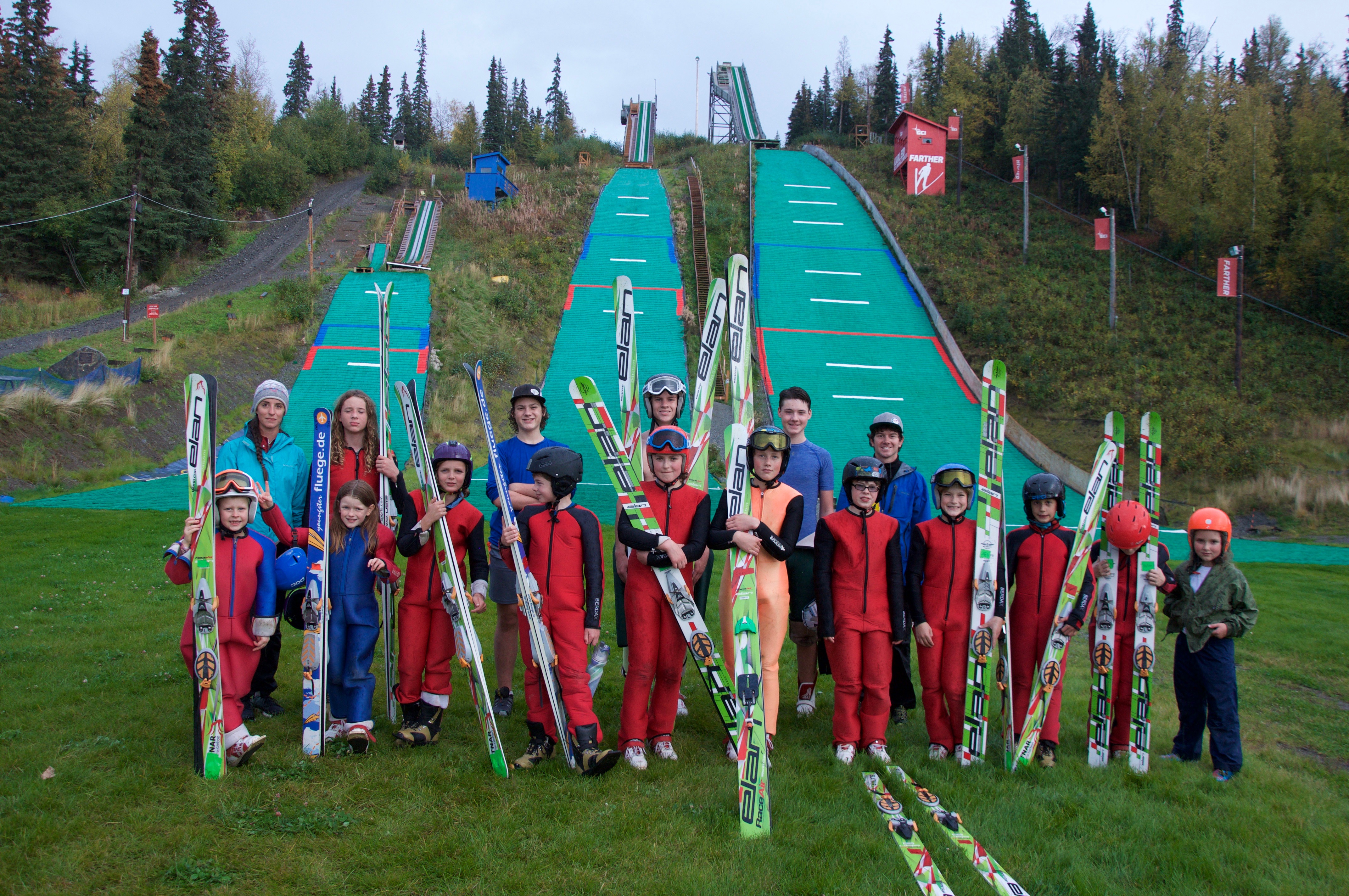
My ski jumping adventure started in Michigan’s Upper Peninsula and later moved even further north, if you can believe that. 4 years ago, I got an amazing opportunity to fly to Anchorage, Alaska and coach ski jumping for 4 months over the winter and then fly home. No strings attached, except for the unknown vacuum that is Alaska itself. I packed my bags and headed north December 1st into the land of 5 hour days, cold weather, and a ski jumping program I knew almost nothing about. Fortunately for me Alaskan hospitality is some of the best in the world and within the first couple weeks I realized that Alaska was the place for me.
Over the last couple of years, I have witnessed and heavily influenced, along with many others, one of the most substantial changes in a ski jumping club. When I arrived in Anchorage, Karen Compton and Vivienne Murray had laid incredible ground work for a ski jumping program, the only thing that was missing was the ski jumping culture. Day one on the job, a standard warm up routine seemed like a foreign language to the club, and imos where completely out of the question. This all seemed so crazy to me growing up in the Midwest where I grew up jumping with one of the deepest ski jumping cultures in the US.
Our first traveling trip really blew me away and I realized that a ski jumping culture had to be created. With a club that supported my every move, we began to develop this culture. With fundraising money obtained prior to my arrival, our plastic project started that following summer and we hired another coach for the small hills, Natasha Mattoon, for the next winter. Luckily for us she got sucked into permanently moving up here as well. Slowly the culture grew and grew. The kids and the parents began to understand the sport, and traveling on trips turned our kids into an actual ski jumping team.
4 years later I am still living and coaching in Anchorage. Ski jumping culture is now alive in Alaska. I know this because my jumpers can actually tell me who a world cup ski jumper is. Gus Compton got to jump with a few of them this summer in Europe. This year we will be hosting Junior Nationals, and I cannot wait to show the rest of the country how far the Alaska ski jumping club has really come. Without a doubt, the future of Alaska ski jumping is as bright as the northern lights on a cold crisp December Alaskan night.  Few people actually get to mold and develop a ski jumping culture, and I feel very fortunate that Alaska gave me that opportunity.
Karen Compton and Vivienne Murray have been visionaries and amongst Alaska’s fervent volunteer base which has launched their club into flight.  Check out this video on ski jumping safety that Team AK Ski Jumping recently worked with USANS to release:

USANS STORY PROJECT 3-DEC 2017- DOUG MAKI

Doug Maki enjoying the ride of his life.  Below he discusses whether returning to some of the less-structured practices of days gone by might make us all a little better.
DOUG MAKI (age 62)
Itasca Ski Club
Coleraine, MN
CURATOR’S NOTE- Doug Maki is a revered and long-time fixture around the Central circuit.  In 2016 he was inducted into both the American Ski Jumping Hall of Fame and the St Paul Ski Jumping Hall of Fame.  He’s got both the wisdom of years and experience.
I can see that the sport of ski jumping has moved forward in the last two to three decades.  We now have things such as snow making, groomers, cut tracks on the in-runs, equipment such as “safety” bindings, skis, boots and helmets.  But there is one aspect that I feel the sport has gone backwards in and that is early season jumping, especially in the Central Division and especially in Northern Minnesota where I am a member of the Itasca Ski and Outing Club of Coleraine.
We have had early snow (early November) this year.  If this was thirty years ago our club skiers would have had 20-30 jumps in by now.  Keep in mind that Coleraine used to have Central training camps every Thanksgiving weekend on our 45 meter jump and sometimes on our 70 meter jump.  This was all done before snow making, groomers and cut tracks.
Now don’t get me wrong, we would have loved to have cut tracks when we were young.  We would have loved to have the groomer take care of the landing hills for us.  This is a wonderful thing.
I realize that today the programs are more structured such as registration, liability waivers, equipment hand out, etc. but this should not keep the jumpers from early snow skiing when the opportunity arises.  Let’s take a look at our young jumpers today.  Most of them are afraid to ride an in-run without a cut track.  I’m not buying it.  I watch them ride the landing hill in their in-run position without a track.  And have you seen the fancy turns and stops that they make at the end of the outrun.  But they can’t go straight down a snow in-run?  Once again, I’m not buying it.
So why is early snow skiing not happening?  It’s not the kids or parents fault, they have never been taught that you can snow in a hill with just shovels, rakes and skis.  This is not something you can Google search. Once again it is not their fault.
I don’t want to sound negative on this topic so what can we do to turn this around so our jumpers can get early snow season training and be ahead of the game when it comes to the competition season?  One answer is for the older members of the clubs to teach the younger generation how to snow in the hill the old fashion way and start jumping early season.
To end my story I am going to sound a little smug.  The jumpers of yesterday would make the jumpers of today look like wimps.  All joking aside though, let’s get this thing turned around.

USANS STORY PROJECT 2-DEC 2017- SOPHIA SCHREINER

Growing up in Westby, Wisconsin I have had ski jumping in my life for a long time. When i was nine we got flyers home from school to start ski jumping with the Snowfake Ski Club. My mom signed me up and my wonderful former coach, Matt Keuler, helped me get started with my passion for ski jumping. Sadly, I was only able to be coached by Matt for 1 year because we moved to Minneapolis. 
Moving to Minneapolis gave me the wonderful opportunity to be able to jump with some truly amazing people at the Minneapolis Ski Club. Skiing with them has been one of the best things that has happened to me. I have made so many bonds with people over the past three years. It has also been amazing having Nick Johnson and Brian Wallace coach me while living here.
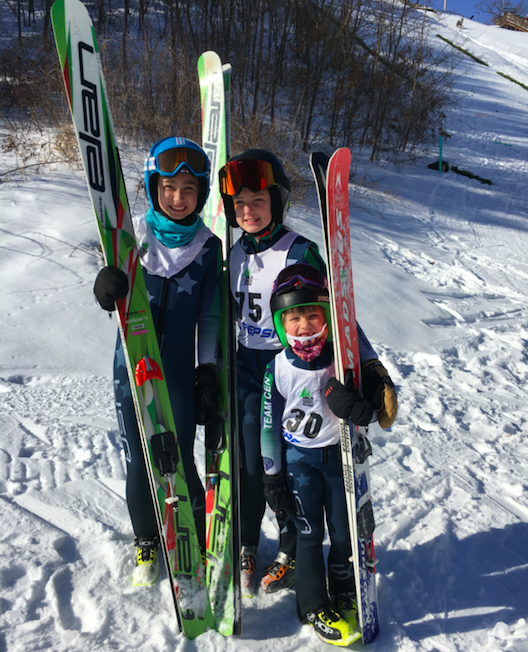
Yes, (left to right) Anna Zigman, me, and Nora Schreiner
I have improved so much and have had the amazing opportunity to compete all over the Midwest. I am also so grateful that my parents are able and willing to drive me to practice, help me reach my goals, give up their free time to bring me to practice, and most of all love me and encouraging me.
Sophia Schreiner
SnowFlake Ski Club, Westby, WI/Minneapolis Ski Club, Minneapolis, MN

USANS STORY PROJECT 1-DEC 2017- SCOTT NICHOLS


Scott Nichols
Ford Sayre Ski Club
Lyme, NH
scott@tarmusa.com

BIG NANSEN

Site of the 1938 Olympic Trials and four national ski jumping championships, Nansen Ski Jump in Milan, NH was last jumped in competition in 1985.  The jump was run by Nansen Ski Club, which remains the  oldest continuously operating ski club in the United States.  After Coach Alf Halvorson brought jumpers to Lake Placid in 1932 for a jump competition the idea of a jump closer to home was conceived.  Word has it that Alf is a man who got things done.  The facility was competed in 1937.  The tower is a steel trestle that soars 50 meters high with an outrun that is another 56 meters high.  The jump is approximately a K80 by today's standards.

In the last 30 years, the jump and grounds had been unmaintained, seemingly the site of nothing more than a place to make donuts with four wheel drives and drink beer.  What originally was a massive landmark clearly visible from Route 16 had practically disappeared into a jungle of trees as thick as dog hair.  Important ski jumping history was disappearing along with the iconic structure.

About two years ago talks began about the historic landmark and its future.  Those talks involved Alf Halvorson's sons Brett and Scott and other members of Friends of Nansen together with Ben Wilson, a preservation specialist from NH Division of Parks and Recreation.   The group decided to improve the jump and grounds enough to share its history again.  They would designate the jump a National Historic Landmark complete with a judges' tower that would be rehabilitated and made into a small museum.
Red Bull found out about efforts at the jump and imagined using the jump in a documentary it was making about Sarah Hendrickson.  A portion of the script was imagined where the rehabilitation of the jump would be symbolic of Sarah's comeback from knee injuries and Sarah would then jump the old monster.  It was agreed that such an event would have synergies for all involved plus Red Bull generously helped fund re-decking the jump to the tune  of $75,000 (the State of NH kicked in another $150,000).  After heroic efforts by Alan Alborn and many volunteers to snow the jump and outrun in terribly dry and cold weather, Sarah jumped Big Nansen successfully.

As a result of Sarah's jump, eyes were opened to further possibilities.  What if Big Nansen could be returned to active status and also a historic landmark?  What if a crowd of several thousand could descend upon Berlin and Milan, NH for lively jumping events?  The East could use another large jump.  What if, as Jeff Hastings envisioned, there could be an Eastern Four Hills Tournament including Lake Placid, Salisbury, Brattleboro, and Nansen?   At first the State was reluctant to consider the possibility of jumping Nansen again, but after several meetings, they've come around to the idea of a living hill.  There is even talk of re-creating the former 40 M hill and getting a local jumping club started again.
The sleeping giant seems to be gaining a pulse now with Friends of Nansen actively pursuing a plan put together by Jed Hinkley to make the jump ready for competition.  The good news is that despite early concerns, a new survey by HEB Engineers reveals that the trestle and outrun are already close to an acceptable profile for today's jumps.  Ken Barker recently visited and toured the jump.  He shared his ideas about how to further prepare the jump and grounds.  The hard work of raising funds, putting milestones on paper, and making upgrades now begins, but there is palpable energy and plenty of expertise engaging on the future of Big Nansen.


Above and below: the recovered Nansen jump today.


Thanks for joining us again for the 7th annual Story Project!  Don't forget to join the list. Last year we we raised almost $200k to fuel our high flying athletes and programs, be the first on the list and Donate now!
Copyright © 2018 USA Nordic Sport INC, All rights reserved.
"You are receiving this email because you have been identified as a supporter/participant of the USA Ski Jumping community.
Our mailing address is:
USA Nordic Sport INC
P.O. Box 683757
Park City, UT 84068

Add us to your address book